
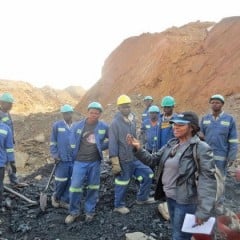
Regional Sharefair 2015
UN Women in collaboration with its key partners will hold a Regional Sharefair on Gender Equality in the Extractive Industries: Building on Good Practices in Nairobi, Kenya from 13 -15 October 2015. The Gender Equality in the Extractives Industry Sharefair builds on the success of the 2014 Rural Agricultural Technologies Share Fair which brought together over 350 participants and 90 exhibitors from across the region. Click here for more information. ...
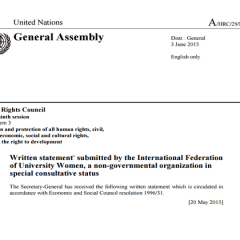
GWI Written Statement HRC29
GWI has submitted a written statement to the 29th session of the United Nations Human Rights Council (HRC29). The statement entitled “Full Realisation of the Right to Education for Girls and Women” emphasises the right to education as a standalone international human right and an enabler of numerous other human rights, which must be promoted, protected and provided to all people without discrimination Education is a catalyst for multisector socio-economic progress including: enhancing sustainable development; fostering fiscal growth; combatting poverty; eradicating illiteracy; and promoting tolerance and peace. There is a concrete and direct correlation between the most fundamental human right of all – the right to life – and its intrinsic connection with the right to education. By providing mothers with a primary level education, maternal death rates would fall by two thirds – saving almost one hundred thousand lives. Extending this paradigm to include mothers with a secondary education, child deaths would be reduced by half, saving a further three million lives. To strengthen the human right to education, in particular for girls and women GWI has made several recommendations for multilateral and multistakeholder committment. Read the statement in full...
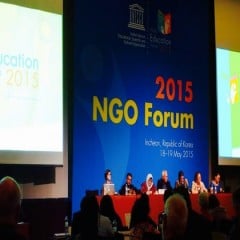
World Education Forum 2015
The seminal World Education Forum (WEF) took place on 18 – 22 May 2015 in Incheon, South Korea. GWI’s Executive Director, Danièle Castle, represented the organisation throughout the Forum. Many high-level speakers took to the floor throughout the Forum, affirming the key message of the universal nature of the right to education. United Nations Secretary-General Ban Ki-moon emphasised that the right to education enabled many other rights including health and employment. Nobel Peace Prize Laureate 2014 Kailash Satyarthi shared the timely and sobering sentiment that “nobody can kill books, pens and education – not even the extremists”. The WEF 2015 NGO Forum culminated in a Declaration, to which GWI contributed. The high-level segment of WEF 2015 also produced an outcome document in the form of the Incheon Declaration, which is fully aligned with the education goal and targets of the global development agenda to be adopted at the UN High Level Summit in September 2015. Highlights and summaries of each day of the Forum are available to view here....
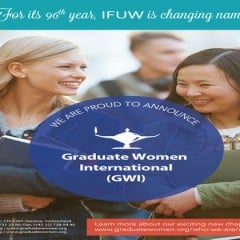
IFUW proudly presents GWI
In its 96th year of championing education, women’s rights and gender empowerment worldwide, 27 April 2015 marks the launch of the International Federation of University Women’s new name of Graduate Women International (GWI). The new title more accurately reflects the dynamism and inclusiveness of the organisation, which is active in advocacy, projects, fellowships and grants. Learn more about the history and transition of IFUW to GWI here: https://graduatewomen.org/who-we-are/our-story/ Read GWI’s first official Press Release discussing the name change here....
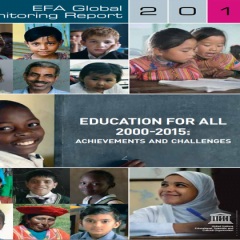
Education For All 2000-2015
UNESCO has published the Education For All Global Monitoring Report 2000 – 2015. The Report takes stock of the progress and challenges in the implementation of the six education goals, adopted in 2000 at the World Education Forum in Dakar, Senegal (“The Dakar Framework”). The seminal event was opened by UNESCO Director-General, Madam Irina Bokova, who was keen to emphasise the persisting, categorical need for more investment and commitment to lifelong education: “Despite not meeting the 2015 deadline, millions more children are in school. However, we need to see specific, well-funded strategies that prioritise the poorest – especially girls – [and] improve the quality of learning and reduce the literacy gap so that education becomes meaningful and universal.” While enrolment in lower secondary school has increased globally by 27% (and more than doubled in sub-Saharan Africa) since 2000, there are still 63 million out-of-school adolescents worldwide. Marginalised children – including those from rural, migrant or weak socio-economic backgrounds – face substantial barriers in accessing and completing secondary education. Increasing the benchmark from universal primary education to universal secondary education is critical to ensure that all students have the foundation skills – including literacy and numeracy – to access the job market, become active citizens, and realise financial independence. Download the EFA GMR report in full here....
